

Shutdown management software for concentrators and mineral processing plants.
Critical shutdown information is spread across ERPs, planning systems, spreadsheets, contractors, supervisors, and the plant floor.
Sights provides an operational layer across your existing ERP, CMMS, planning systems and field workflows, connecting shutdown strategy, plans, work packages, documentation and live execution in one operational system. During execution, it brings dispatch-style control to maintenance work.
Evaluate Sights against your shutdown environment, systems, and priorities.
Take ownership of the STO lifecycle
Sights houses and connects the work across the STO lifecycle, then carries the approved plan into field execution. As actual starts, completions and delays are recorded, downstream timing and forecasts update to reflect how the shutdown is unfolding against the plan. The resulting execution data provides the basis for reporting and continuous improvement.
Strategy
Build a shutdown strategy based on measurable drivers: wear, risk, backlog, and critical path, helping teams clearly define the necessary work and prevent unnecessary jobs.
Readiness
Track the status of work packages, materials, documentation, and resources, so readiness gaps are visible and resolved before execution begins.
Execution
Bring dispatch-style control to shutdown maintenance. Communicate planned work and timing to field teams, capture actual execution, and automatically update dependent activities and forecasts as conditions change.
Reporting
Capture actual progress, field events, and delay causes in a structured record, helping teams make future shutdown decisions based on verifiable data.
How Does Sights Work?
Strategy & Drivers
Ancillary liners are often replaced during major shutdowns because access is available instead of liners reaching the end of their useful life. Sights uses two-point UT measurements and processed tonnage to calculate wear rates and forecast the required liner thickness for the next operating cycle. This allows teams to align ancillary liner life with planned shutdown intervals, reducing premature replacements and wear-related mid-cycle stops while directly improving maintenance cost per tonne.
Planning & Readiness
Sights houses shutdown plans and reusable work packages connected to production lines, equipment and recurring maintenance requirements. Each package can bring together schedules, SOPs, permits, risk assessments, lift plans, tools, materials and other execution-critical documentation, while ERP integration keeps procurement status visible. Plans can be grouped, saved and exported, allowing teams to reuse established work rather than rebuild recurring shutdown jobs across disconnected files. Readiness gaps remain visible before execution begins, reducing delays caused by missing information, materials or approvals.
The Mill Reline Module
When contractors control reline planning, mines may lack the task-level data needed to challenge durations and commercial assumptions. Sights provides the structure and task-level execution data required to support Level 6 reline planning, including individual tasks, inching sequences, LOTO activities, shift changes, breaks, and handovers. This enables tighter, evidence-based schedules, strengthens contractor cost control, and helps reduce both avoidable contractor time and lost production.
Execution Control & Verification
A static schedule cannot remain accurate once field conditions begin to change. Sights communicates assigned work and timing to supervisors and field teams, captures actual starts, completions and delays, and automatically shifts dependent activities to maintain a current completion forecast. For designated LOTO points, required photo verification must be completed by the assigned supervisor or operator before dependent work can be activated. This creates a traceable control between isolation and execution while giving shutdown leadership a current view of progress, constraints and forecast exposure.
Reporting & Continuous Improvement
When execution detail is not captured as work occurs, critical context is often lost before final reporting and post-shutdown review. Sights preserves task-level progress, actual durations, delay causes, notes, and verification evidence in a structured record of the event. This data generates automated S-curves and factual KPIs. Sights gives teams a common factual basis for determining where and why time was lost, reducing disputes between stakeholders and ensuring continuous-improvement priorities are driven by operational evidence.
Offline Capability & Integration
Sights is designed for the physical and digital realities of mineral processing operations. Field teams can continue recording progress without reliable connectivity, with updates synchronized using their original timestamps once a connection is restored. API and OPC connectivity allow Sights to work alongside compatible ERP, CMMS, scheduling, and plant systems rather than replace them. This extends shutdown visibility to the plant floor while preserving the enterprise architecture and established workflows already in place. Sights is designed for deployment within 30 days, subject to scope, system access, and integration requirements.
Every shutdown environment differs across assets, systems, constraints, and established workflows. Review your requirements with us and determine where Sights could support your operation.
The Complete STO Lifecycle in One System
The views below illustrate selected stages of the shutdown lifecycle from readiness and live execution to post-shutdown analysis. They represent only a small part of the wider planning, coordination, verification, reporting, and improvement capabilities available in Sights.
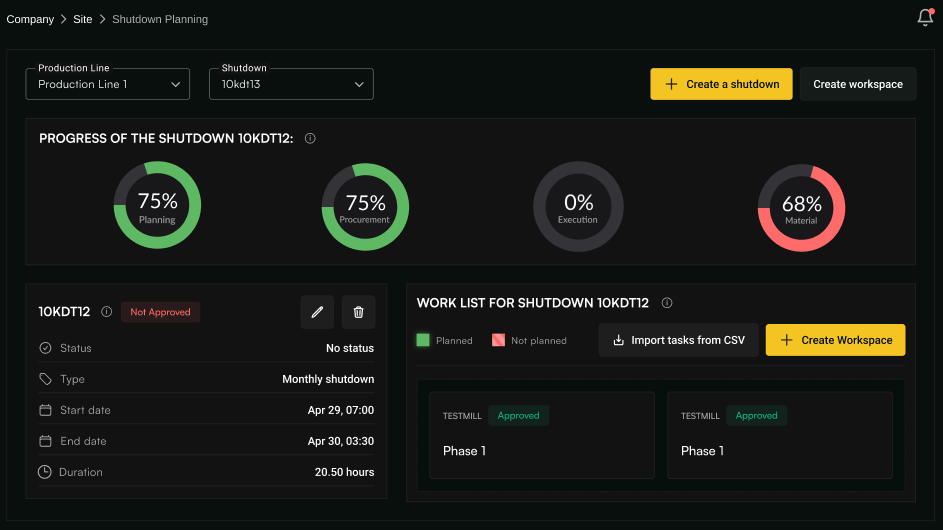
Readiness
Review planning, procurement and materials status and identify gaps at a glance.
Execution
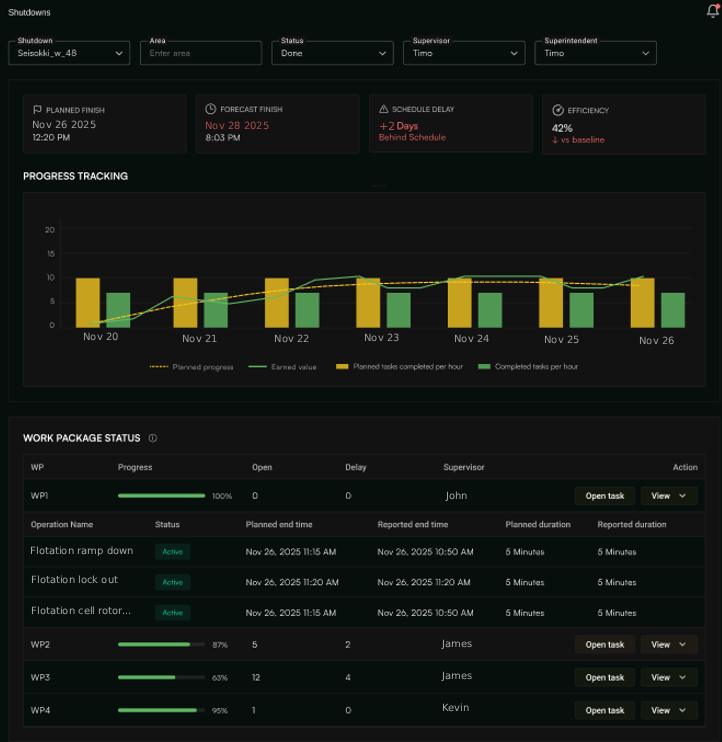
See dispatch-style shutdown control in practice
Compare planned and actual progress, monitor work-package status, and identify developing schedule delays as execution unfolds. Task-level records give teams the detail required to intervene during the event while building reliable duration data for future shutdown and reline planning.
Continuous Improvement
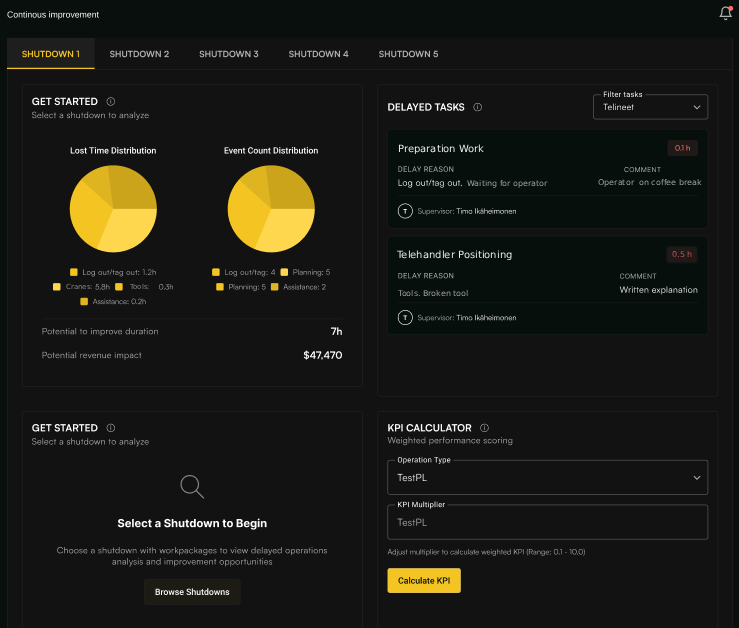
Turn execution data into measurable improvement
Compare patterns across shutdowns and trace delays to specific tasks and causes. Sights gives post-shutdown reviews a shared factual basis for prioritizing improvements and quantifying their potential effect on shutdown duration and production.
Sights is built on more than 20 years of experience managing maintenance and shutdowns at some of the world’s largest concentrators, including operations processing up to 85 million tonnes annually. That experience informs how Sights approaches readiness, field execution, verification, reporting, and continuous improvement.
How Does Sights Help You?
Compare shutdown performance across sites and establish consistent operating standards across the portfolio.
-
Compare shutdown duration, delay causes, readiness, and execution performance across assets.
-
Identify best practices and standardize them across the portfolio.
-
Track whether improvement initiatives produce measurable results from one event to the next.
Maintain oversight of shutdown performance easily
-
Monitor whether readiness and execution remain aligned with production and availability commitments.
-
Understand where delays create production, cost, or schedule exposure.
- Maintain a verifiable record of safety-critical controls and shutdown execution.
-
Review shutdown outcomes from a consistent, evidence-based record rather than relying solely on consolidated summaries.
Keep shutdown scope, readiness, execution, and maintenance outcomes under control.
-
Confirm whether work packages, materials, resources, and documentation are ready before execution.
-
Identify where developing constraints threaten shutdown duration or plant availability.
- Confirm that required isolations and verification points are complete before dependent work proceeds.
-
Use historical performance and wear data to improve future scope, timing, and maintenance decisions.
Strengthen control and traceability around safety-critical shutdown activities.
-
Define verification requirements for designated LOTO points and critical activities.
-
Maintain photo evidence linking assigned personnel, timestamps, lock points, and task release.
-
Review a structured record of completed controls without reconstructing events after execution.
Direct attention toward the areas where intervention will have the greatest effect.
-
Compare planned and actual progress across work packages, areas, shifts, and contractors.
-
Identify emerging critical-path constraints before they become schedule overruns.
- See which lock points remain outstanding and prevent downstream work from starting prematurely.
-
Use current field information to coordinate resources and prioritize operational intervention.
Build shutdown work that is complete, reusable, and ready for execution.
-
Reuse recurring work packages instead of rebuilding the same jobs for each event.
-
See where materials, documentation, tools, permits, or approvals remain incomplete.
-
Use actual task durations from previous shutdowns to create more realistic schedules.
Coordinate field execution and maintain a reliable record of progress as work occurs.
-
See current and upcoming activities, dependencies, and verification requirements.
-
Record progress, delays, cause codes, and completion evidence close to the work.
- Complete assigned LOTO verification with photo evidence and release dependent work through a controlled sequence.
-
Coordinate handovers and dependent activities using current task-level information.